Markdown to PDF: How to Generate Professional PDFs with md-to.com for Free
Markdown is great for writing, but when it’s time to deliver, you often need a PDF.
Technical proposals, project reports, resumes, even homework assignments — Markdown is the best format for writing, but eventually you need to hand someone a PDF file (they might not have a Markdown editor, and they certainly don’t want to read raw .md source code). PDF is the universal delivery format: fixed layout, cross-platform, print-friendly.
The question is, how do you elegantly convert Markdown to PDF? LaTeX is too heavy, Pandoc’s command line is too complex, and online tools raise privacy concerns.
Good news: MD TO’s Markdown to PDF feature takes just 3 steps — free, online, locally processed, and the resulting PDF looks great.
Why MD TO’s Markdown to PDF Feature?
- 3 steps, done: Paste Markdown → choose a template → download PDF. Zero learning curve
- 20+ professional templates: Business, Minimal, Academic, Tech, Creative — five categories to fit any scenario
- Real-time preview: Live rendering on the right side, what you see is what you get
- 100% local processing: All conversion happens in your browser, nothing uploaded to servers
- Completely free: No limits, no watermarks, no signup required
- Smart pagination: Code blocks, tables, and images won’t be split across pages; headings never appear orphaned at the bottom
- Code highlighting + math formulas: Two must-haves for technical documents, fully supported
Simply put, it’s a “paste and convert” tool, but the output is far more professional than you’d expect.
3 Steps to Convert Markdown to PDF
Step 1: Enter Your Markdown
Open md-to.com/markdown-to-pdf/. The left side is the Markdown editor, the right side is the live preview.
Three ways to input content:
- Paste directly: Copy your Markdown text and paste it into the editor
- Upload a file: Drag and drop a
.mdfile into the editor area - Load example: Click “Load Example” to quickly try it out
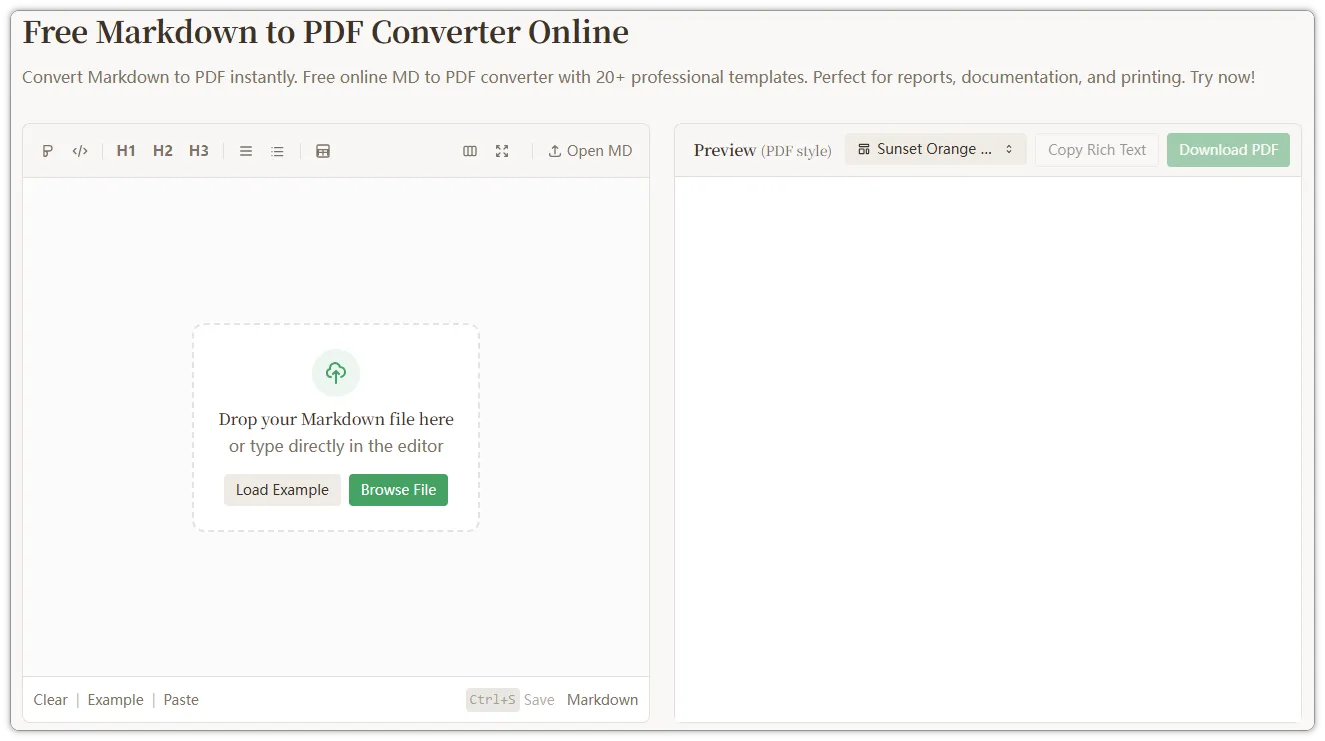 Figure 1: md-to.com editor interface — Markdown input on the left, real-time preview on the right
The editor supports full Markdown syntax — headings, lists, blockquotes, code blocks, tables, links, images, math formulas. The right-side preview updates in real time.
Tip: For large Markdown files, drag-and-drop upload is more convenient than pasting.
Step 2: Choose a Template and Preview
After entering content, click the template name above the preview area to open the “Document Style” panel.
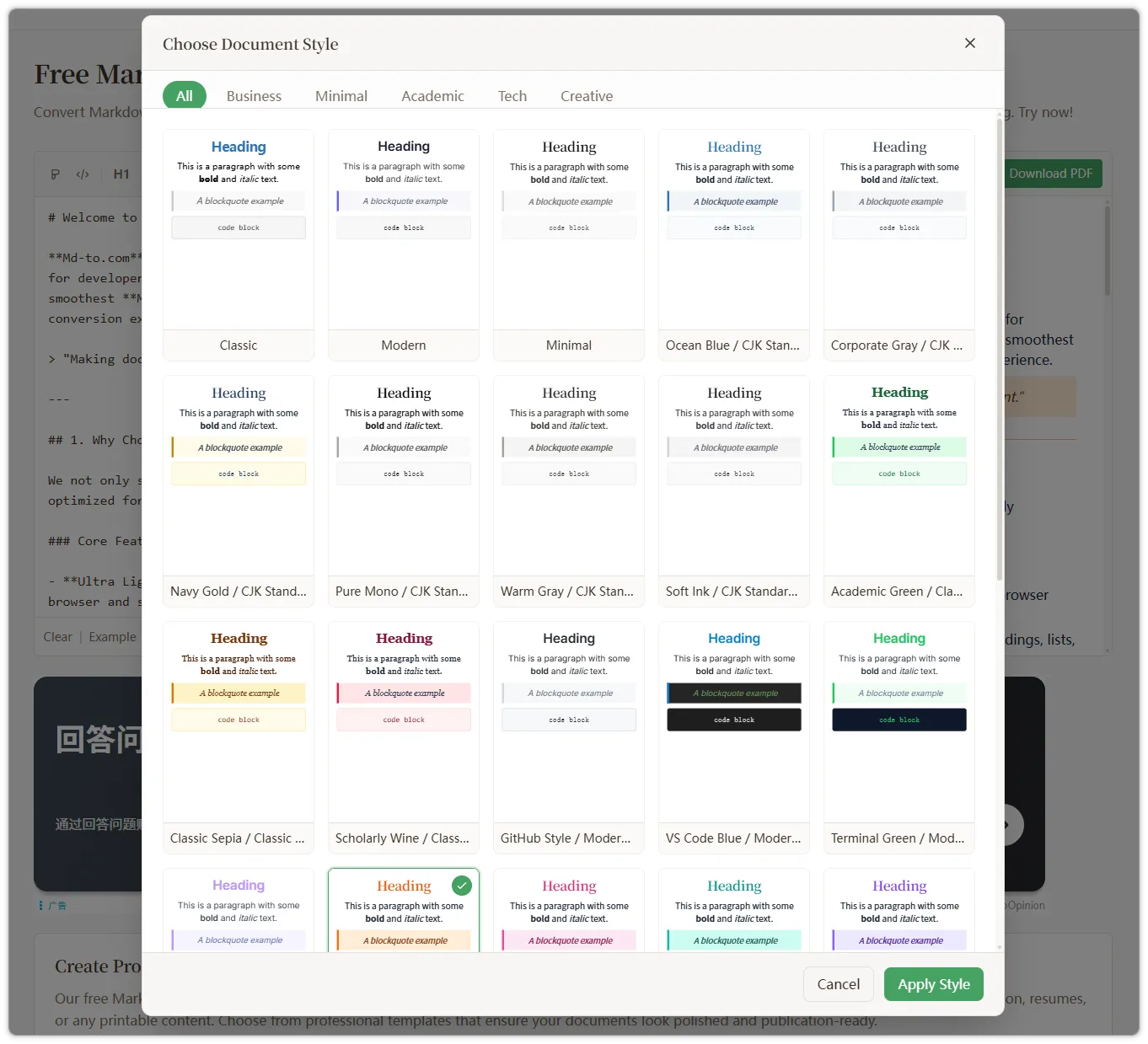 Figure 2: Document Style panel — 20+ templates in 5 categories
20+ templates in 5 categories for different scenarios:
| Category | Example Templates | Best For |
|---|---|---|
| Business | Classic, Ocean Blue, Business Gray, Navy Gold | Project reports, proposals |
| Minimal | Simple, Pure Black & White, Warm Gray, Soft Ink | Resumes, tech blogs |
| Academic | Academic Green, Classic Brown, Academy Wine | Papers, coursework |
| Tech | GitHub Style, VS Code Blue, Terminal Green, Dracula Purple | Technical docs, API docs |
| Creative | Sunset Orange, Cherry Blossom Pink, Ocean Teal, Lavender | Portfolios, creative docs |
The preview refreshes in real time as you switch templates. Click “Apply Style” when you find one you like.
Recommended pairings:
- Technical proposals / API docs → GitHub Style, VS Code Blue
- Project reports / business docs → Business Gray, Navy Gold
- Resumes / personal docs → Simple, Pure Black & White
- Academic papers / coursework → Academic Green, Academy Wine
Step 3: Download PDF
Click the “Download PDF” button to open a full-screen preview. Here you can see the final PDF result — exactly as it will look when printed.
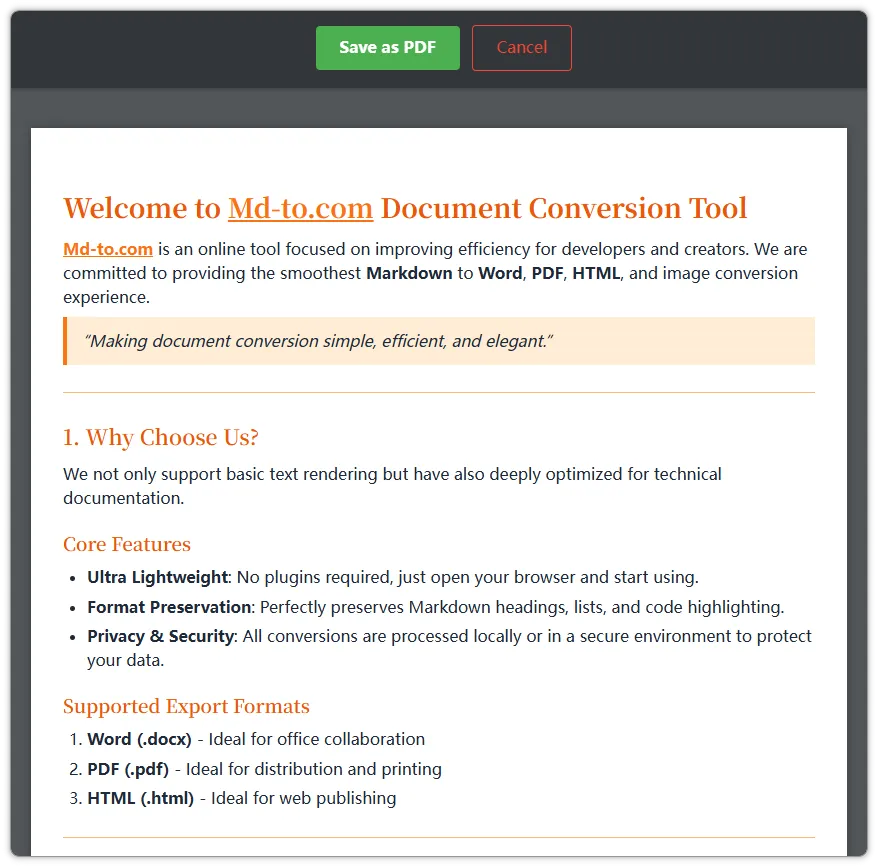 Figure 3: Full-screen PDF preview — exactly as it will look when printed
Once confirmed, click “Save as PDF”. Your browser’s print dialog will appear:
- Set Destination to “Save as PDF”
- Click “Save”, choose a location, and you’re done
That’s it. Your Markdown is now a beautifully formatted PDF document.
Standout PDF Features
Smart Pagination
This is where md-to.com really shines. Content won’t be crudely cut in the middle during PDF conversion:
- Code blocks stay intact on the same page
- Tables can span pages, with headers repeated on each page
- Images and blockquotes remain whole
- Headings are never orphaned at the bottom of a page — they always stay with their content
These details require manual LaTeX parameter tweaking in Pandoc, but md-to.com handles them automatically.
Code Highlighting
The soul of technical documentation. md-to.com’s PDF export preserves full syntax highlighting across 50+ programming languages. Python, JavaScript, Go, Rust, SQL — whatever the language, your code retains its colors and readability in the PDF.
Math Formulas
LaTeX math formula rendering is fully supported. Both inline and display formulas render correctly, perfect for academic papers and technical documents. Formulas stay intact across page breaks.
Smart Filenames
Downloaded PDFs aren’t all named download.pdf. md-to.com automatically extracts the first heading from your Markdown as the filename. If your document starts with # Project Technical Proposal, the file will be named Project Technical Proposal.pdf.
What Formats Are Preserved?
Basic formatting:
- Headings (H1-H6)
- Bold, italic, strikethrough
- Ordered and unordered lists (with nesting)
- Blockquotes
- Inline code and code blocks (with syntax highlighting)
- Links and images
- Horizontal rules
Advanced features:
- Code block syntax highlighting (50+ languages)
- Tables (with cross-page header repetition)
- Task lists (checkboxes)
- Math formulas (LaTeX)
- Nested lists (multiple levels)
Practical Tips
Print Dialog Settings
After clicking “Save as PDF”, the browser’s print dialog has a few important settings:
- Enable “Background graphics”: This is the most important step. Without it, template backgrounds and code block colors will be lost, and the PDF will turn plain black and white
- Paper size: Default is Letter; you can also choose A4 (more common in some regions)
- Margins: The defaults work fine — templates already set appropriate padding
Choosing the Right Template
Different scenarios call for different levels of formality:
- Reports for management: Business Gray or Navy Gold — restrained colors, formal layout
- Technical review docs: GitHub Style or VS Code Blue — best code readability
- Resumes: Simple or Pure Black & White — clean and sharp
- Student work: Academic Green or Academy Wine — scholarly but not dull
Long Document Tips
For documents over 10 pages, we recommend:
- Use clear heading hierarchy (H1 → H2 → H3) for better pagination
- Consider splitting long code blocks to avoid overly long single blocks
- Keep table column count manageable — very wide tables may get compressed
Common Use Cases
Developer: Technical Proposals & API Docs
Writing a tech proposal or API reference? Pair your Markdown with the GitHub Style or VS Code Blue template. Code blocks retain full syntax highlighting, and smart pagination keeps your code intact across pages — no more manually tweaking page breaks.
Student: Papers & Course Assignments
Need to submit a PDF for class? The Academic Green or Academy Wine templates give your work a scholarly look. LaTeX math formulas, blockquotes, and nested lists all render correctly — ideal for papers that mix text, formulas, and citations.
Professional: Project Reports & Business Documents
Weekly reports, project summaries, client proposals — the Business Gray or Navy Gold templates deliver a polished, formal PDF. Paste your Markdown, pick a template, and hand your manager a professional document in under a minute.
md-to.com vs Other PDF Solutions
| Aspect | md-to.com | Pandoc + LaTeX | Typora Export |
|---|---|---|---|
| Ease of use | Zero barrier, opens in browser | Requires installation + CLI | Requires desktop app |
| Templates | 20+ beautiful templates | Requires custom LaTeX templates | 5-6 themes |
| Code highlighting | 50+ languages, automatic | Requires listings configuration | Supported |
| Math formulas | LaTeX supported | Native support | Supported |
| Privacy | 100% local processing | Local processing | Local processing |
| Price | Completely free | Free (open source) | Paid $14.99 |
| Pagination | Automatic smart pagination | Manual parameter tuning | Basic pagination |
| Cross-platform | Any browser | Requires environment setup | Win/Mac/Linux |
Key difference: Pandoc is the most powerful but has a steep learning curve, suited for users with LaTeX experience. Typora is an excellent desktop editor but requires payment. md-to.com’s advantage is zero barrier + rich templates + completely free, perfect for “I just want to quickly convert to PDF.”
FAQ
Q: Can the exported PDF be edited?
PDF is a fixed-layout format and not designed for direct editing. If you need an editable document, use md-to.com’s Markdown to Word feature to export as DOCX.
Q: The background colors / code block colors are missing?
Enable “Background graphics” in the browser’s print dialog. This is the browser’s default behavior — it doesn’t print background colors by default to save ink. Enabling this option preserves all styles.
Q: Can I choose A4 paper?
Yes. In the browser’s print dialog, you can select A4, Letter, or other standard sizes.
Q: Will images display correctly?
If your Markdown references publicly accessible image URLs, they’ll display correctly in the PDF. Local image paths need to be uploaded to the web first.
Q: Is my data safe?
Completely safe. All conversion happens in your browser using JavaScript. Your Markdown content is never uploaded to any server. Your data never leaves your device.
Q: Which browsers are recommended?
Chrome or Edge are recommended — their “Save as PDF” print dialog works best. Firefox and Safari are also supported, though some style details may vary slightly.
Q: Can I use it on my phone or tablet?
Yes. md-to.com is fully responsive — you can edit and preview on mobile devices. That said, for the best experience with longer documents, we recommend using a desktop browser or a tablet in landscape mode.
Q: Does the PDF have headers and footers?
By default, the browser may add headers and footers (page URL, date, etc.) when printing. You can turn these off in the print dialog settings by unchecking “Headers and footers” to get a clean PDF.
Wrapping Up
Converting Markdown to PDF with md-to.com takes just 3 steps:
- Paste or upload your Markdown content
- Choose the right template
- Click “Download PDF” and save as PDF file
Smart pagination, code highlighting, math formulas, 20+ templates — features you won’t always find together in other free tools. Most importantly, 100% local processing means your content stays yours and is never seen by anyone else.
Try it now at md-to.com/markdown-to-pdf/.
Related tools:
- Markdown to Word - Convert MD to editable DOCX
- Markdown to Image - Convert MD to beautiful long images
- Markdown to HTML - Convert MD to HTML code